Showing posts with label David Cameron. Show all posts

Tuesday, 14 December 2010

Apathy in the UK

"The death of democracy is not likely to be an assassination from ambush. It will be a slow extinction from apathy, indifference, and undernourishment."
Robert M. Hutchins, 1899-1977

A recent comment response to a post on this humble blog came with a call to "live with the result and don't whine about it" as "What's been done is not illegal, it may be slightly shady but that's life." While loath to get into the specifics of the nature of the call, or indeed the blog post in question, this response, rather than anger or irk, saddened me as it is symptomatic of widespread attitudes towards activism or, to put it more generally, caring within today's world.

Not long after the comment appeared, around about six weeks ago I began writing this post. It was primarily influenced by this, but also to a general sense of impotence which seemed to be arising around certain issues: for instance the lack of reaction to a student protest petition against proposed redundancies at Grays School of Art, with The Robert Gordon University's acting principal John Harper's response nothing more rather dismissive rhetoric and an empty statement to the effect that "I’m confident that the recommendations will ensure that the University continues to produce a steady stream of talented graduates who will drive the regional creative and cultural economy." The assurance that "Further consultation sessions with students will be arranged at the appropriate times" seemed enough to dissuade a number of students from taking the matter any further feeling it was outwith their control.

I was, at the time, poised to write a post discussing this, and also the binds of non-disclosure agreements which restrict academics disclosing their opinions of the growing corporation of Universities and education and the general levels of apathy which have dominated the British Public. However, I focused on another set of topics I believed more pressing at the time before returning to this post in an attempt to get it down, when this happened:

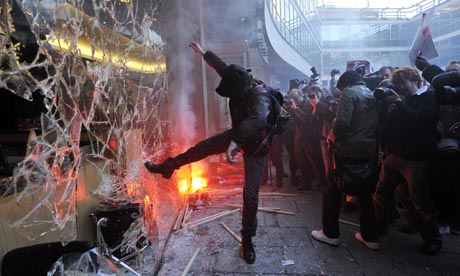
Millbank Tower Protests - Photograph: Ray Tang/Jonathan Hordle/Rex Features
 On the 10th of November the first in a series of marches opposing the proposed rises in student tuition fees and they're oft-overlooked stablemate - an 80% Reduction in teaching budgets - deviated from their proposed route and resulted in the occupation of Conservative Party Headquarters at Millbank Tower. The bulk of the media coverage concentrated on the "violence at Tory HQ [that] overshadow[ed] student fees protest" with reports of the broken window as pictured above and case of a fire extinguisher thrown from the roof of the tower. While the action was quick to be condemned: by Aaron Porter of the NUS as "despicable"; David Cameron as "unacceptable"; while Boris Johnson accusing those in occupation as having "abused their right to protest" the condemnation mostly tars the occupation and the violence which occurred at Millbank Tower with the same brush.

The Guardian's John Harris argues that while indeed it was a small minority who brought the violence with them, it was not a small minority who had marched on Millbank Tower: "You had only to look at the crowd to know that the vast majority of them were not anarchists, but reasonably regular twentysomethings. As if to illustrate the point, when one of the people on the roof made the stupid decision to hurl down a fire extinguisher, they were met with an outraged chant of "Don't throw shit! Don't throw shit!"" Going on, Harris quotes an exchange from a colleague who had spent the day at Millbank "talk of cynical provocateurs, he said, was "nonsense": the crowd was made up of "ordinary students who were viscerally angry", but also mindful of what was ill-advised, or plain daft. When one of their number had prised up a cobblestone and moved to lob it at the police, he had been roundly told to "stop being an idiot.""

While I am certainly not going to condone or advocate violence on this blog, whether be towards a protester, innocent or police officer who is merely doing their job, I will say that it is something I can understand, and something which was justified in a statement from lecturers at Goldsmith's College "The real violence in this situation relates not to a smashed window but to the destructive impact of the cuts." Anger and discontent is widespread and rising amid the lies and hypocrisy being espoused by those in government and the rapid and alarming breakdown of the basic principals of democracy.  It seems the democratic process only comes into force once every four or five years (depending on jurisdiction) when an election approaches and the general population is required to see one party (or two as is currently the case) into power. Even then this year's UK elections have seen even the polling booth to be a hollow gesture where the thoughts and opinions of the voters mean nothing, given the Liberal Democrats finding themselves in a position to turn the tide of political governance mostly based on a pledge which they apparently planned to drop regardless of the outcome. It is unseen how a Lib Dem pre-election pledge which did get through, the "powers of recall" will effect the Liberal Democrat mandate to govern, but it is very clear that the student occupation of Millbank tower was "just the beginning."

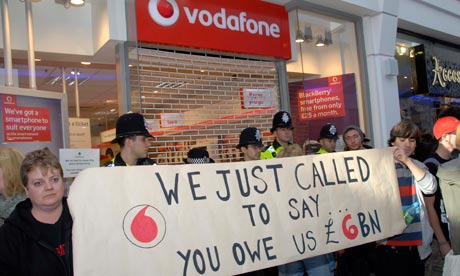
UK Uncut protest in Brighton. Photograph: Howard Davies/www.reportdigital
In late October, after Private Eye revealed that the HM Treasury had allegedly "agreed a deal to let Vodafone off a £6bn tax bill" people took to the streets in protest. "Four shops in central London were forced to close on Saturday because of the demonstrations, sparked by a campaign on Twitter and Facebook" with other branches being targeted across the UK. The campaign quicky gained weight becoming "UK Uncut" as their protest gained momentum and demonstrations continued with growing regularity despite HM Treasury dismissing the allegations saying "There is no question of Vodafone having a tax liability of £6bn. That number is an urban myth" and Vodafone themselves claiming that "We pay our taxes in the UK and all of the other countries in which we operate" , even though recently "Indian tax authorities have given Vodafone 30 days to pay a 112bn rupee ($2.5bn, £1.6bn) tax bill."

As the demonstrations have grown in numbers and frequency, UK Uncut have widened their targets, moving on to tackle high-street chain, Topshop, and in particular its founder Philip Green who is also accused of Tax Avoidance. UK Uncut claim that "In 2005 Philip Green awarded himself £1.2bn, the biggest paycheck in British corporate history. But this dividend payout was channeled through a network of offshore accounts, via tax havens in Jersey and eventually to Green’s wife’s Monaco bank account. The dodge saved Green, and cost the tax payer, close to £300m." Green in particular has been targeted as he was in august appointed to "lead an efficiency review of government spending" while Liberal Democrat MPs called for an investigation into his tax dealings.

As the commons vote on the tuition fees on 9th December approached two more protests occurred on the 24th and 30th in the capital with many more emerging across the country. Following from the Goldsmith's College Occupation last month, students across the country began to occupy their University buildings and for the first time pupils occupied their schools in protest as the biggest demonstration march approached to coincide with the crucial vote. Despite Downing Street's condemnation of lecturers who had supported the protests at Millbank, lecturers, trade unionists and schoolchildren joined the students in the protests last week. Following criticism of the policing of the protests a month earlier, the Metropolitain Police were infinitely more prepared for the trouble which emerged when the protest again deviated off course and saw thousands of protesters enter Parliament Square.

The Guardian's live blog of the day can fill in most details as they happened. As the protesters broke into Parliament Square the Police switched to riot gear and began employing the controversial "kettling" technique to contain the protesters in one area. In practice, however, it appears to have exacerbated the situation, creating a bottleneck and effectively trapping people - including teenage schoolchildren - within the Square. Student groups came out accusing the police tactics of provoking violent reaction, with the Guardian's live reaction blog highlighting cases of apparent contempt from Police towards protesters, reports of police dragging a cerebral palsy sufferer from his wheelchair (video, below), and student Alfie Meadows, a 20 year old protester "suffered bleeding to the brain when he was struck by a police truncheon during the tuition fees protest." A few days after the protest a video emerged showing an officer policing the protest without displaying her shoulder ID, following the death of Ian Tomlinson at the G20 protests in 2009 Metropolitan Police Commissioner had condemned the action: “I have made it absolutely clear that it is absolutely unacceptable for any officer who should have identification numbers on not to have those identification numbers on.


Following last week's protests, Sir Hugh Orde, president of the Association of Chief Police Officers stated that the repeated clashes with protesters and demonstrators would begin to threaten the reputation of the police "if it is allowed to be played as the cops acting as an arm of the state, delivering the elected government's will, rather than protecting the rights of the citizen." While the policing of these events is part of the Job description, the increasing conflicts, questionable tactics and growing discontent are bound to erode the relationship between the police and the general public, it wont be long before discontent spreads into the police ranks. Police Forces throughout the country are not immune to the same round of cuts which are angering students, with warnings that "40,000 officers would lose their jobs if the police budget was slashed by 25%" and Home Secretary Theresa May telling Met Commissioner Paul Stephenson to "brace for an 11 per cent cut in government funding over the next two years."

As the police launch an investigation into the events of 9th December, with students blaming police tactics for the violence, and the police and government condemning a "significant number [who] came intent on violence", however will the investigation pinpoint who is really provoked and caused the violence and protests: the Coalition Government?

When you look beyond the media emphasis on violence which undermines the voices of campaigners and masks the real issues, that of a systematic dismantling of the education system and the UK Government's unflinching bias towards big business.The Government continues to hand over policy-making roles to representatives from business such as Philip Green and ignore the wishes of the voters, including inviting fast food giant MacDonalds to inform public health policy. Education is not simply a tool to be used by commerce or business in order to train workers into functional obedience. A day after the Government voted through the rise in fees a statement from CBI Director General Richard Lambert states "business will have to play a much more active role than it has in the past in informing students about its likely future needs" even going further to suggest that business should be influencing which courses Universities offer and steering the choices which students have to make much earlier. Society as a whole benefits from an educated populous, it is a right and not a privilege, which drives forward innovation and invention and should be free and accessible to all.

Friday, 5 November 2010

Art for a Few, Education for a Few and Freedom for a Few


"Money is a magical phenomenon. Because there's nothing there. You didn't burn, for example, food. Most of the governments of the world destroy food every day so as not to bring down the market price. You didn't burn Art (the pictures on the notes are okay, but you wouldn't want them on your wall); you didn't burn Literature -both of these things are burnt every day; you didn't burn people. What you burnt was paper that is a symbol of value."

Alan Moore, on the K Foundation's burning of £1 Million
from The K Foundation Burn a Million Quid, 1995
A conflicting argument to Moore's assessment of money can be found in the musical Cabaret which debuted on Broadway in 1966, that of the song lyric Money Makes The World Go Round, which has become somewhat of a motto for those occupying the board rooms of the huge corporations around the world, as well as those gambling every day in The City and on Wall Street. Far from being billions of years worth of cosmic dust barrage from even before the formation of the planet, money plays no part in the rotation of the Earth. In fact, if anything, Money may be the one thing that will cause the world to stop rotating, burst into flames and fall out of the sky.

Mark Wallinger: Save The Arts
Last week's Comprehensive Spending Review as announced by our new leaders in the coalition government, aiming to "terminate the budget deficit" in full over the next four years. The main event has been the announcement of £81 billion worth of cuts to Government spending in order to combat the £115 billion deficit, with the remaining balance to be met by raising taxes, such as the impending VAT increase from 17.5% to 20% in January. The spending cuts include (in no particular order): 50% in social housing; 8% in Defence; State pension age to rise to 66 for both men and women; "funding for police will be cut by 20%"; "60% cut in capital spending and Educational Maintenance Allowances"; "Department for Business, Innovation and Skills (BiS) is to be cut by 7.1%."; "Sport England ... funding cut by 33%"; A freeze in the Science budget which works out as "a cut of less than 10% over four years" in real terms; "3,000 fewer criminals in prison"; Abolition of 192 quangos; "7.5% real terms reduction in revenue and another 41% reduction in capital funds" for Wales; "£4bn cuts in the budget" for Northern Ireland; "7% cut in resource spending and 38% cut in capital spending" for Scotland; 30% to the Arts Council of England; and 40% to Universities. Of the few departments to have been "spared" in the spending review, the NHS budget "will rise by £10bn."

Despite the Conservative's pseudo-socialist rallying cries that "we're all in this together" it appears the banking community are getting away quite lightly in terms of cuts in comparison to every other aspect of society. With the spending review came a "new bank levy [that] will raise about £2.5bn a year from 2012", to allow the banks whose pivital role in 2008's Credit Crunch sparked the global financial meltdown, and the price tag for the UK bailing out it's banks, which came to around £850 Billion led to the country having such a massive budget deficit. Financial Secretary Mark Hoban said rightfully that banks should "make a fair contribution in respect of the potential risks they pose to the UK", however early indications are that the "levy would be set at 0.04% in the first year and would then rise to 0.07%", nowhere near as as huge a drop or as big a saving as being faced throughout the rest of society. Leading government think tank, the Institute for Fiscal Studies has already hit out at the spending review, with claims that "poor people would be hit harder than the rich", but in the meantime leading banks such as Goldman-Sachs are willing to continue to pay out massive bonuses, with their vice-chairman, Conservative peer Lord Griffith calling on the taxpayers to "tolerate the inequality as a way to achieve greater prosperity for all". Other banks are hitting out at the supposed "severity" of the rates levy, despite "The Treasury spent the summer consulting" the banking industry, something it failed to do for the rest of the population.

Lord Browne
The restructuring of the finances in Higher Education were not put out to consultation, or in fact given over to one of the hundreds of qualified specialists in this sort of thing who are already working for the Government through Universities, this particular pleasure was allocated to Lord Browne, former head of BP and House of Lords crossbencher, whose only apparent insight into Universities was that he had been to one. Browne's report, which was used as much of the basis for George Osborne's radical reshaping of the finances of Universities, outlined that "tuition fees which are capped at £3,290 a year, should be raised to as much as £7,000" sparking fears that we could end up in a situation where "that students are essentially consumers who should pay for services they receive – the more upmarket, the higher the price." However following the spending review, Lib-Dem Business Secretary Vince Cable and Deputy Prime Minister have made assurances that the cuts would be capped, with Mr Cable telling BBC News "I don't think there's any prospect of having unlimited fees - that simply isn't going to arise."

However during the election campaign, the Liberal Democrats made a firm pledge dedicate to "Scrapping university tuition fees during first degrees" entirely, and have since faced "the first serious revolt within the Liberal Democrat party since the formation of the coalition" with Lib Dem MP Greg Mulholland stating that "It is certainly my belief that this is not a done deal and the strength of feeling among Lib Dem MPs could derail any attempts to see fees rising substantially and I will certainly be doing everything I can to make that happen"  and former party leader, Sir Menzies Campbell adding that "It would drive a horse and cart through my credibility in my capacity both as chancellor and as an MP if I were to renege on that pledge – and I don't intend to." With an uncertain track record on the issue and, according to the Guardian, Conservative sources disagreeing with Clegg and Cable "that elite universities should have the freedom to charge what they like", which led Aaron Porter, of the National Students to warn that "A market in course prices between universities would increasingly put pressure on students to make decisions based on cost rather than academic ability or ambition."


As well as the proposals for tuition fee increasing, the review, or Securing a Sustainable Future for Higher Education,  outlined in section 6.2 PUBLIC INVESTMENT WILL BE TARGETED ON THE TEACHING OF PRIORITY SUBJECTS, outlining that public investment in teaching budgets would be reserved for subjects which a perceived "prority" defined as  "Typically the courses that may fall into this category are courses in science and technology subjects, clinical medicine, nursing and other healthcare degrees, as well as strategically important language courses." An Observer Editorial surmised that "The big problem with Lord Browne's report is not in the mechanism it uses to develop new funding streams, but in the fact that it uses that mechanism as a pretext to slash teaching grants", indeed the realities of the suggestions outlined by Lord Browne were brought through in Osborne's spending review by cutting the Higher education budget "from £7.1bn to £4.2bn by 2014." Before the report was published, The University and Colleges Union warned “Cuts of this magnitude will leave many cities and towns without a local university and our students paying the highest public fees in the world." with Aaron Porter surmising that "The true agenda of the coalition government this week is to strip away all public support for arts, humanities and social science provision in universities and to pass on the costs directly to students' bank accounts."

Backing up the fears of the NUS, University Minister David Willetts, while announcing the £9000 cap on fees told the Daily Mail of his desire to "rate degrees by the employment rates and salaries of graduates, ...  the best degrees to be given ‘kite marks’ by professional associations as an indication that they are rated highly by employers. which the Mail, in its usual non-sensationalist style described as a "war on pointless degrees." It seems that Universities, once places of education, morality and thinking are, since their transferral to the Department for Business, Innovation and Skills are simply another tool for "economic prosperity" and wealth generation.

With the Spending Review came announcement of the Arts Council of England facing a "29.6% cut [which] will see ACE's current government grant of £449m drop to £349m by 2014" which included a condition that cuts of 15% would be required to be made from regularly funded organisations which could mean that "at least 100 arts organisations will lose their funding." As alarming as the thirty percent cuts are in themselves, the condition placed on the arts council in how to administer almost half of these cuts has been criticised for eroding the "arms-length" policy by which the Arts Council does its business, in a move akin to washing his hands of the affair, Culture Minister Ed Vaizey stated "We've made it clear that it's a condition of their settlement that ACE limits cuts to the overall RFO budget to 15%; but if they choose not to fund certain organisations that is their decision." going on to say should the ACE not comply with the condition that "Life would get very interesting."

As the dust settles, ACE has already begun outlining how its cuts would be made, which would include "7% first-year reduction for regularly funded organisations." and "£6 million from savings due to the postponement of a major public engagement project, cuts to our audience development plans, and to funds for partnership working with local authorities and the private sector." Aside from the ACE, "The British Film Institute will see its budget cut by 15%" while a "budget cut by 16%" by a six-year freeze in the licence fee and covering the costs of the World Service would see the BBC loosing a "total of £340m of extra money annually" and being described as the "moment when the BBC sacrificed its fiercely defended independence for a role akin to another government department."

North of the Border we will have to wait until the end of this month to hear John Swinney's Proposed Budget for the next fiscal year outlining how Scotland will deal with the "£900m reduction", although at the moment unknown, some suggest that there is very little left to cut. The two issues discussed above, that of Education and Culture are devolved issues, dealt with and administered by our SNP Government, who's future is in the balance given the upcoming Scottish Elections in May. However Scotland faces its own cultural confusion around the emergence of the Creative Scotland, and already our education establishments are preparing to weather the storm, while others are beginning to crack under pressure.

As previously mentioned, the Robert Gordon University, an institution which has long held the principles outlined by David Willetts and the Daily Mail at the core of its educational ethos, a University which proudly boasts that "business and entrepreneurship lie at the heart of much of the university’s academic offering," and its "best rates of employment in graduate-level jobs" have announced that "Given the current public spending environment it is important that the University addresses resource issues now to avoid greater challenges in the future." To this end, using the impending public spending cuts for Scotland as a handy excuse, the University intends to deal with a budget deficit of £370, 000 at Grays School of Art, one of Scotland's Four Art Schools, by informing staff that "a voluntary severance scheme would be available for those wishing to be considered." The poetic irony of the move is that the results of a consultation, and the announcement of the redundancies and reprofiling of the School is to be made on November 15th, the day before the 125 Anniversary of the School's founding.

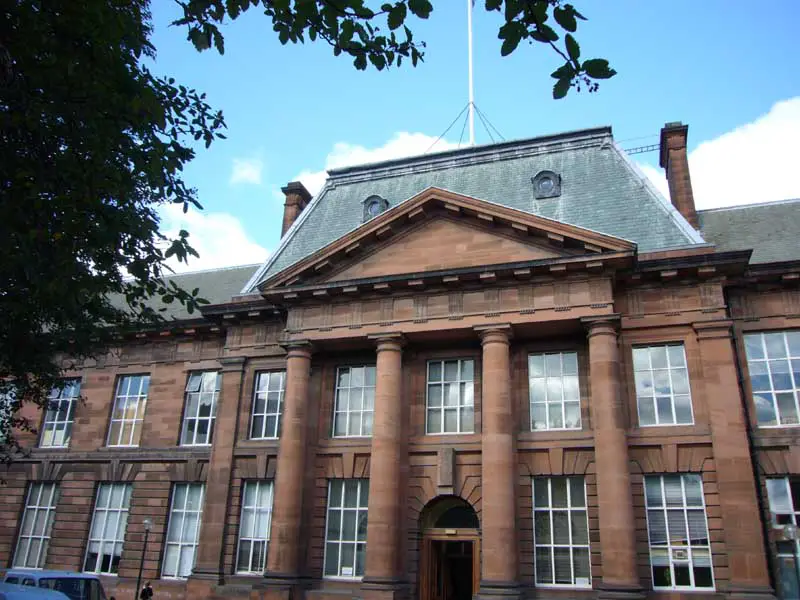
Edinburgh College of Art: Crisis
Meanwhile, at Edinburgh College of Art news of a merger with Edinburgh University was mooted with reports that "ECA principal Professor Ian Howard sent a letter to staff explaining that the move was being examined in the light of the current economic situation." the letter outlined how the merger brought "very exciting possibilities for enhanced teaching, research and creative endeavour" with The Scotsman describing how "As a joint institution, the two could make substantial savings by sharing facilities and services, such as human resources, libraries and student accommodation. Buildings made redundant could be sold off." "It [University of Edinburgh] will work with the college [ECA] in securing a financially sustainable future" described Melvyn Cornish, Edinburgh University Secretary,  however, the news did not bode well for ECA alumni. Dr Barbara Rae, Chair of the Alumni Association stated that "We believe it imperative to safeguard the Edinburgh College of Art in the same way the Glasgow School of Art is respected and revered, both founded long ago to explore and promote originality in the arts" and within days of the announcement it emerged that four governors of the College had resigned over the matter, with Lady Mathewson declaring that "I and my fellow governors who have resigned no longer have confidence in the Chairman or Principal who have driven through an incomplete merger proposal that has now been put out to public consultation, excluding key financial information."

Attempting to quell the furore, an ECA spokeswoman refuted Lady Mathewson's allegations "the suggestion that there has been a failure to explore the options or to ensure transparency in the process is entirely untrue." This was before the real nature for the merger plans emerged.  The Sunday Herald revealed that "The University of Edinburgh and ECA are asking the Scottish Funding Council (SFC), the body that funds higher education in Scotland, for £13.8m to enable the merger. The majority of this, £9m, is to bail out ECA’s bad debts" also detailing a building maintenance bill of £44.1 Million to the College's estates which are reported to be only worth 37.3 Million - were Edinburgh College of Art a car it would be a write off.

Much of the College's cash woes centres around the redevelopment of Evolution House in the City's Westport. The Sunday Herald article points out that "The college has spent £21m on Evolution House but it is now worth only £10.6m" and "that Lloyds Bank could in theory at any time require repayment of the whole £11.5m loan, because the college’s financial performance has meant covenants with the bank have been breached." Among other shady dealings, ECA has been granted a £1.6m advance from the Scottish Funding Council, and borrowed almost half of its Andrew Grant Scholarship fund, a move which the report claims "the university’s own legal advice suggests that it is not clear that the trustees were working within the law in making this loan.” All in all, the leaked document paints a disturbingly glum picture of the College's financial situation, which also states that "“ECA would not now be trading if it had not received advances of grant from the SFC.”

These two cases provide a horrifying hammer blow to half of Scotland's Higher Education Art Provision, before the cuts outlined in the Spending Review have even taken effect in Scotland. The uncertainties surrounding the provision of arts and humanities education was spelled out by Natalie Fenton, Deputy Head of Media and Communications at Goldsmith University, where students yesterday began an occupation in protest to the education cuts and tuition fee rises: "This is a massive cut to higher education and a slashing of the public subsidy for teaching, which will hit the arts, humanities and social sciences particularly hard if the science budget is going to be protected.

"Some institutions will close, and it's inevitable there will be mass redundancies across the sector. Goldsmiths will be forced to take on an enormous number of international students who pay higher fees to make up for the cuts. Class sizes will rise, they'll be humongous; the staff-student ratio will rocket and nobody will be satisfied.

"Some institutions will close, and it's inevitable there will be mass redundancies across the sector. Goldsmiths will be forced to take on an enormous number of international students who pay higher fees to make up for the cuts. Class sizes will rise, they'll be humongous; the staff-student ratio will rocket and nobody will be satisfied. "By only protecting science, they're signalling that arts, humanities and social sciences are worthless. But these are the disciplines that engender civility, and teach empathy and tolerance."

The next four years look set to be grim, with some claiming these are the "biggest spending cuts since 1945" but what is the outcome of the cuts, what exactly are they for? While David Cameron and his LibDem human shield, Nick Clegg, are quick to defend the cuts in terms of fairness: "Fairness is actually about asking how much people give as well as how much people get and I think that we have done it in a way so we can genuinely say it is difficult, it is tough but it is fair" and senior Tories such as Lord Ashcroft urging everyone to see the "bigger picture." However no one in Government is looking at the "bigger picture", the picture they are looking at is 156mm x 85mm and has the queen's face on it and a bunch of numbers.

The motivation behind the Comprehensive Spending Review is by no means far-sighted, in no way looks towards any notion of a "bigger picture", it is simply an exercise in backpedaling, with the way of life of everyone in the country paying for the mistakes and reckless gambling of the few. The spending review is based on the idea that "reducing the deficit is a necessary precondition for sustained economic growth", but essentially it is about reducing how much debt the county is in so we can start over again, return to the status quo and let the cycle run its course once more. "The Spending Review is underpinned by a radical programme of public service reform, changing the way services are delivered by redistributing power away from central government and enabling sustainable, long term improvements in services", but it in no way examines how we got in this mess in the first place, it no way intends to reform the fiscal system to which we are all unwitting prisoners. Love it or loath it, the capitalist system by which our wold prescribes has failed, not just in the last two years since the nightmare of the Credit Crunch, but it has always failed, it is destined to fail. Every ten to twenty years we find ourselves in the same situation, it happened in the mid seventies, the early eighties, the early nineties and now the late 2000s, and what always happens is a "tightening of the belt", cuts to frontline public services until economies begin to grow again and then we just get back to the way things were.

The difference with the current round of recession-beating belt-tightening is the severity of the cuts we are facing, estimates of "1.6 million job losses across the public and private sectors", the erosion of the welfare state, closure of Universities and Arts Organisations, small business crippled by an increase in VAT. Once you cut these vital services, "reform" education, close business it will be very difficult to get them back, it has taken sixty years to build the UK to the powerhouse of creative and cultural initiatives, and that could be completely reversed in less than four. And even then the nature of the focus of the cuts, with emphasis placed in the wrong place: "The coalition is now poised to take billions out of the economy, all in the hope of unleashing a private sector recovery based on manufacturing and exports. But to whom? The strategy relies on wide-open borders and eager consumers with money in their pockets. That is not how the global economy looks right now."

A reform of the ecomonic system, perhaps a movement away from a monetary based system (given that, according to Moore, it is based on something that doesn't exist in the first place) would require a sort of global joined-up-thinking which our politicians and managers seem unable to engage in. It would require putting aside petty differences, it would require putting aside nationalism, imperialism and one-upmanship. It would require the global communities to sit down and think about a solution which is better for the world, one which not only takes into consideration economies, but other global concerns, overpopulation, depletion of natural resources, climate change etc. However to think on this scale would require looking at what is best for the many, rather for the few, and what is best for all of society and the planet, not just the west.

It would require the relinquishing of the the very thing that money represents: power. And with power comes control, and inequality, as former US president said in 1826 "There are two ways to conquer and enslave a nation. One is by the sword, the other is by debt."